
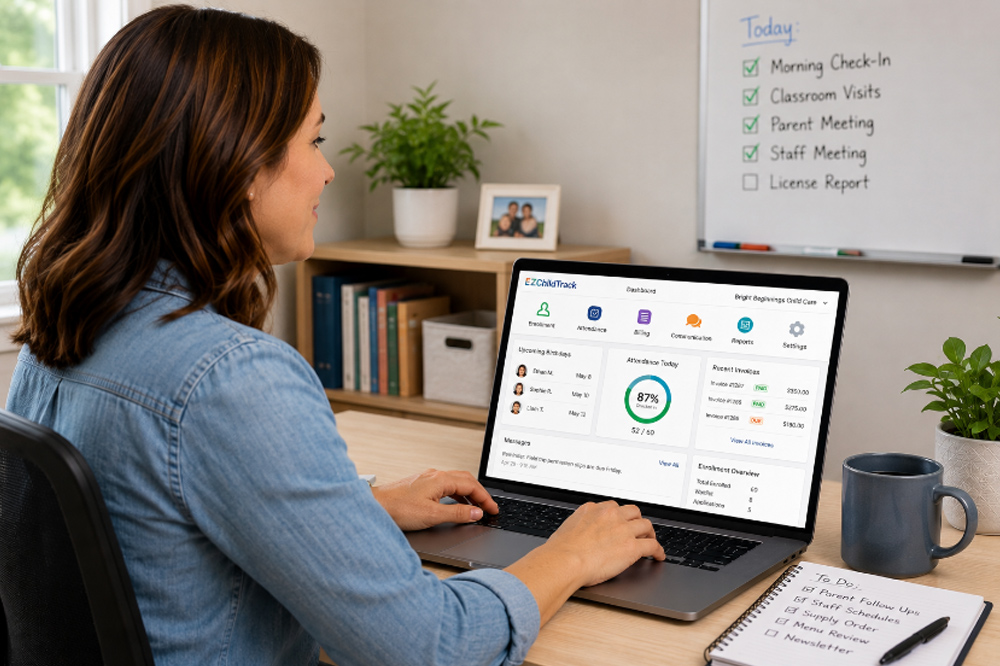
If you've ever walked into work and immediately been hit with questions like, "Did that parent finish registration?" "Has that payment come through yet?" or "Who's covering the afterschool room today?" then you already know how quickly a normal day can turn into a game of tracking down information.
Running a childcare center or afterschool program means juggling a lot of moving pieces. Enrollment, attendance, billing, parent communication, staffing, licensing requirements, and day-to-day operations all need your attention at the same time. The longer your program has been around, the more moving pieces there seem to be.
Yet some programs always seem calm and organized, even during their busiest times of year. They're not necessarily working longer hours, and they don't always have larger teams. More often than not, they've simply found a way to stay ahead of administrative tasks before they become bigger problems.
That's what allows them to spend more time focused on children, families, and the quality of their program instead of constantly putting out fires.
Table of Contents
- Why Some Programs Always Feel Like They're Playing Catch-Up
- The Most Organized Programs Don't Rely on Memory
- Small Administrative Problems Become Big Problems Quickly
- Consistency Creates Better Experiences for Families
- What Research Says About Family Expectations
- What Organized Programs Do Differently
- How EZChildTrack Helps Programs Stay Organized
- Frequently Asked Questions About Childcare Management Software
- Final Thoughts
Why Some Programs Always Feel Like They're Playing Catch-Up
Most directors don't feel overwhelmed because they're disorganized. They feel overwhelmed because important information is spread across too many places.
Maybe registration forms are stored in one system, attendance is tracked somewhere else, billing lives in a spreadsheet, and parent communication is scattered across emails, texts, and handwritten notes. None of those things seem like a major issue on their own.
The challenge is that every time someone needs an answer, staff members have to stop what they're doing and go searching for it. A typical day might include helping a parent update enrollment information, checking whether a payment was received, verifying attendance for a child who arrived late, responding to a family question about scheduling, covering a staffing change, and preparing information for reporting requirements.
When all of that information lives in different places, even simple tasks can take longer than they should. That's often why some programs feel like they're constantly catching up while others seem to move through the day more smoothly.
The Most Organized Programs Don't Rely on Memory
If you've ever had a team member say, "I think I saw that form somewhere," you know exactly what this section is about.
Many programs unknowingly rely on memory more than they realize. One person knows where enrollment records are stored. Another remembers which parents still owe payments. Someone else knows which classroom has attendance updates that haven't been entered yet.
The problem is that information becomes difficult to manage when it's tied to individual people instead of a consistent system. The programs that seem incredibly organized usually aren't doing anything magical. They've simply made it easier to find information when they need it.
That's one reason many growing childcare centers eventually move away from manual processes and toward childcare management software. Not because they want more technology, but because they're tired of wasting time hunting for information. When enrollment records, attendance, billing, and family communication all live in one place, your staff spends less time searching and more time actually helping families.
If your staff spends too much time searching for information, the problem may not be your team, it may be your system. EZChildTrack helps afterschool programs and childcare centers keep enrollment records, attendance, billing, and family communication organized in one centralized platform so your staff can spend less time tracking things down and more time focused on children and families.
Small Administrative Problems Become Big Problems Quickly
Most operational challenges don't start out as major problems. They start as little things: a registration form that never got completed, an unpaid invoice that wasn't noticed right away, an attendance record that wasn't updated, or a parent message that accidentally slipped through the cracks.
None of those situations are unusual. In fact, they're incredibly common.
The issue is that small problems tend to pile up when nobody has visibility into what's happening across the program. Before long, you're spending valuable time trying to reconstruct information instead of simply accessing it.
The programs that stay organized are usually the ones that can spot these issues early. They know what's missing, what's overdue, and what needs attention before it becomes urgent. That saves time, reduces stress, and helps staff stay focused on the work that matters most.
Consistency Creates Better Experiences for Families
Families may never see your attendance system. They may never know how billing is processed, and they probably don't think about your registration workflows.
What they do notice is when things feel organized.
They notice when communication is timely, when registration is easy, when billing is accurate, and when questions get answered quickly. Those seemingly small interactions shape how families feel about your program as a whole.
Families today are also used to convenience in almost every part of their lives. They can schedule doctor's appointments online, pay bills from their phones, and receive real-time updates from schools and businesses. As a result, they increasingly expect the same level of convenience from childcare and afterschool programs.
Many programs use online registration and parent communication tools to create a smoother experience for families from day one. Programs that make things easier for families often create:
- Smoother enrollment experiences
- Stronger parent communication
- Fewer administrative frustrations
- Higher levels of trust
- Better long-term retention
The experience families have outside the classroom matters just as much as what happens inside it.
What Research Says About Family Expectations
Family expectations have changed significantly over the past decade.
Research from the National Association for the Education of Young Children (NAEYC) continues to highlight the importance of strong family engagement and communication in early childhood programs. Strong communication helps build trust, strengthen family partnerships, and create more positive experiences for both children and caregivers.
For program leaders, that means organization isn't just an internal benefit. It directly affects how families experience your program from the very first interaction.
What Organized Programs Do Differently
The busiest programs aren't always the most stressed. In many cases, they're simply working from better information. They know:
- Where enrollment stands right now
- Which families still need to complete paperwork
- What attendance trends look like
- Which invoices remain unpaid
- Where staffing adjustments may be needed
- Which parent communications still need follow-up
That doesn't mean problems never happen. It simply means they're easier to identify and address before they become larger issues.
Organization isn't really about being neat. It's about having the information you need when you need it.
How EZChildTrack Helps Childcare Programs Stay Organized
At some point, most growing programs realize spreadsheets simply aren't enough anymore. Not because spreadsheets are bad, but because there's only so much information your team can manage when enrollment, attendance, billing, communication, and reporting all live in different places.
You need tools that help your team stay organized without creating more work.
EZChildTrack helps childcare centers, preschools, and afterschool programs manage:
- Online registration and enrollment
- Attendance tracking
- Billing and payments
- Parent portal
- Staff scheduling
- Reporting and operational oversight
By keeping everything centralized in one system, your team spends less time tracking down information and more time focused on children, families, and the overall success of your program.
See How EZChildTrack Can Help Your Team
Simplify enrollment, improve communication, streamline billing, and spend less time managing spreadsheets by scheduling a demo today.
Frequently Asked Questions About Childcare Management Software
What is childcare management software?
Childcare management software helps childcare centers and afterschool programs manage enrollment, attendance, billing, parent communication, reporting, and other daily administrative tasks in one place.
How does childcare management software help programs stay organized?
By centralizing information, childcare management software makes it easier for staff to access records, track attendance, communicate with families, manage billing, and stay on top of daily operations.
What features should childcare management software include?
Most programs look for online registration, attendance tracking, billing and payment processing, parent communication tools, reporting capabilities, and staff management features.
Is childcare management software useful for afterschool programs?
Yes. Many afterschool programs use childcare management software to manage enrollment, attendance, family communication, payments, and daily operations across one or multiple sites.
How can childcare software improve family communication?
Many platforms offer parent portals, messaging tools, automated notifications, and online access to important information, making communication easier for both staff and families.
Final Thoughts
The busiest programs aren't always the ones working the hardest. More often, they're the ones that have figured out how to keep information organized, accessible, and easy to manage as their programs grow.
When your team has better visibility into enrollment, attendance, communication, billing, and daily operations, it's easier to stay ahead of problems instead of constantly reacting to them. And that gives you more time to focus on what brought you into this work in the first place: supporting children, serving families, and creating a program people love being part of.